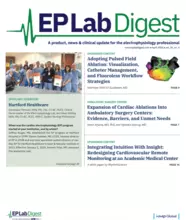








Breaking Barriers: Bringing Cardiac Ablation to ASCs
Interview With Arash Aryana, MD, PhD, FACC, FHRS
Interview With Arash Aryana, MD, PhD, FACC, FHRS
© 2026 HMP Global. All Rights Reserved.
Any views and opinions expressed are those of the author(s) and/or participants and do not necessarily reflect the views, policy, or position of EP Lab Digest or HMP Global, their employees, and affiliates.
EP LAB DIGEST. 2025;26(4).
Interview With Arash Aryana, MD, PhD, FACC, FHRS
In this episode of The EP Edit, we’re joined by Dr. Arash Aryana to discuss what it really takes to build an ambulatory surgery center (ASC)-based ablation program, why adoption has been slower than expected, and what needs to happen next to scale this model responsibly.
Transcripts
In your 2026 Western AFib presentation, “Atrial Fibrillation (AFib) Ablation in the ambulatory surgery center (ASC): Implementation and Tips,” what are the most critical steps programs must address when transitioning AFib ablation from the hospital outpatient department to the ASC setting?
Programs must ensure facility readiness, including appropriately configured recovery areas to support same-day discharge (SDD), continuous monitoring, and reliable power backup redundancy. Operational workflows must be deliberately designed with adequately staffed teams that include cross-trained nurses and technicians proficient in electrophysiology (EP) equipment and procedures, as well as anesthesia teams experienced in outpatient AFib ablation protocols.
Equally critical is a robust emergency preparedness infrastructure. Programs must establish clear escalation pathways, enable rapid recognition and management of complications, formalize transfer agreements with nearby hospitals, and conduct regular simulation training and emergency drills.
Finally, regulatory compliance is foundational to sustainability. ASC programs must satisfy applicable state and federal requirements, including state licensure processes, certificate-of-need approval where required—not all states require this—as well as certification by the Centers for Medicare & Medicaid Services (CMS). This necessitates meticulous documentation of procedural volumes, anesthesia records, quality metrics, and complication tracking to demonstrate adherence to established standards of safety and quality.
Your EP Lab Digest article outlines the evidence base supporting AFib ablation in ASCs, including safety data and CMS’s 2026 policy shift. How do you see this reimbursement change and reshaping access, economics, and the overall landscape of EP care?
CMS’ inclusion of cardiac ablation codes on the ASC Covered Procedures List marks a pivotal moment in the evolution of EP care. By allowing Medicare beneficiaries to receive cardiac ablations outside the traditional hospital outpatient departments, this policy expands geographic access, alleviates pressure on hospital-based EP labs, and often reduces patient out-of-pocket costs due to the lower ASC site-of-service expense.
From an economic perspective, this shift reinforces the viability of physician-led ASC models while offering a lower-cost care setting for payers, potentially rebalancing negotiating leverage between hospitals and independent EP practices. Over time, this change is likely to drive a migration of routine, lower-acuity ablations to ASCs, while more complex cases remain hospital-based, fostering a tiered and decentralized EP care ecosystem.
To support this transition responsibly, continued investment in infrastructure, staffing, emergency preparedness, and rigorous quality oversight will be essential to maintain safety and optimize clinical outcomes.
Despite strong safety data and growing demand, EP migration to ASCs has lagged behind other procedural specialties. What do you see as the biggest barriers to this, and what solutions are needed to responsibly scale AFib ablation in the ASC environment?
Despite strong safety data and growing procedural demand, the migration of EP, particularly AFib ablation to the ASC setting, has lagged behind other specialties. This slower transition is less a function of intrinsic clinical complexity and more a reflection of structural, financial, and operational barriers. Although AFib ablation requires specialized equipment and coordinated periprocedural care, contemporary techniques, standardized workflows, and advances in mapping and energy delivery have made the procedure increasingly reproducible and well-suited to a SDD model for appropriately-selected patients. Accordingly, the principal constraints to ASC expansion are infrastructural and economic rather than clinical in nature.
Regulatory and administrative complexity also remain important impediments. State licensure requirements, variable regulatory restrictions, and certificate-of-need processes, where applicable, continue to delay development and expansion of EP ASCs. In parallel, capital intensity poses a significant hurdle as well. Establishing an EP ASC requires investment in mapping systems, ablation platforms, imaging capabilities, anesthesia infrastructure, and monitored recovery space designed for safe SDD. Many programs have been reluctant to commit capital without confidence in stable reimbursement and long-term payment alignment. Operational readiness also represents a critical consideration. Successful ASC ablation programs depend on cross-trained nursing and technical staff, anesthesia teams experienced in outpatient protocols, and clearly defined discharge pathways. Workforce shortages and variability in staffing models have therefore slowed adoption to a greater degree than procedural complexity itself.
Responsible scaling of AFib ablation in ASCs should emphasize systems-level development. Key elements include standardized patient selection criteria, optimized SDD protocols, formalized hospital transfer agreements, routine emergency simulation training, and rigorous outcomes tracking to ensure transparency and quality assurance. Additionally, thoughtful capital alignment strategies, such as physician-hospital partnerships or value-based reimbursement arrangements, can also mitigate financial risk while supporting sustainable program growth.
In summary, expansion of AFib ablation into the ASC environment is constrained less by clinical feasibility than by the need for disciplined operational design, capital planning, and regulatory navigation. As explored in my forthcoming EP Lab Digest article, the field would highly benefit from a physician-governed, nationally coordinated, specialty-aligned framework capable of providing comprehensive operational, regulatory, and technical support for the development of EP-capable ASCs, without necessitating corporate ownership. Such a model would preserve physician autonomy while supplying the infrastructure required for safe, efficient, and scalable growth of ASC-based care in EP.