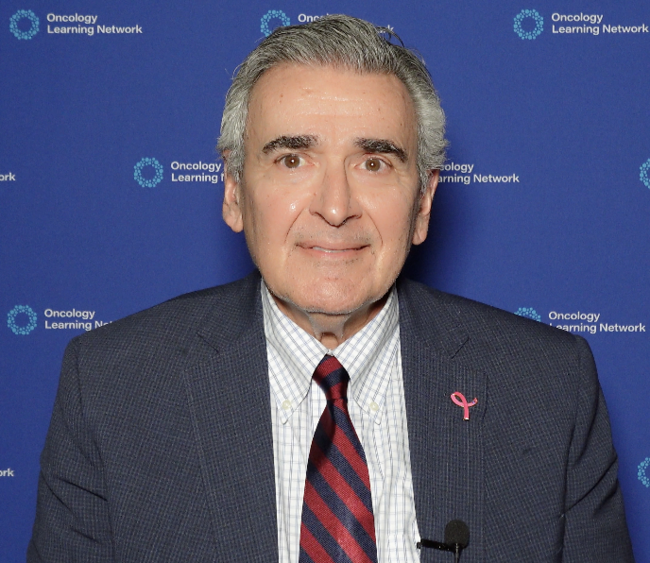
Sami Diab, MD, discusses recent updates to the NCCN Clinical Practice Guidelines in Oncology for Breast Cancer, which reinforces the Breast Cancer Index® as the only genomic test predictive of benefit from extended endocrine therapy in...
Sami Diab, MD, discusses recent updates to the NCCN Clinical Practice Guidelines in Oncology for Breast Cancer, which reinforces the Breast Cancer Index® as the only genomic test predictive of benefit from extended endocrine therapy in...
Joseph Sparano, MD, discusses new findings from the TAILORx multimodal AI analysis, which identified that multimodal AI models, particularly the ICM+ model, significantly outperformed traditional models for predicting late distant recurrence...
Joseph Sparano, MD, discusses new findings from the TAILORx multimodal AI analysis, which identified that multimodal AI models, particularly the ICM+ model, significantly outperformed traditional models for predicting late distant recurrence...
Aditya Bardia, MD, discusses results from the phase 3 lidERA trial showing giredestrant significantly improved invasive disease-free survival compared to standard endocrine therapy for patients with ER-positive, HER2-negative early-stage...
Aditya Bardia, MD, discusses results from the phase 3 lidERA trial showing giredestrant significantly improved invasive disease-free survival compared to standard endocrine therapy for patients with ER-positive, HER2-negative early-stage...
Results from a phase 2 trial suggest that sintilimab plus anlotinib demonstrates encouraging efficacy with manageable safety among patients with relapsed/refractory small cell lung cancer (SCLC) who have a short chemotherapy-free...
Results from a phase 2 trial suggest that sintilimab plus anlotinib demonstrates encouraging efficacy with manageable safety among patients with relapsed/refractory small cell lung cancer (SCLC) who have a short chemotherapy-free...
Updated results from the phase 3 CAPSTONE-1 trial demonstrate that adebrelimab plus chemotherapy continues to provide durable survival benefit in patients with extensive-stage small cell lung cancer.
Updated results from the phase 3 CAPSTONE-1 trial demonstrate that adebrelimab plus chemotherapy continues to provide durable survival benefit in patients with extensive-stage small cell lung cancer.
Exploratory results from the phase 3 IMforte trial suggest that first-line treatment with lurbinectedin plus atezolizumab delays subsequent therapy and maintains overall survival benefit in patients with extensive-stage small cell lung cancer.
Exploratory results from the phase 3 IMforte trial suggest that first-line treatment with lurbinectedin plus atezolizumab delays subsequent therapy and maintains overall survival benefit in patients with extensive-stage small cell lung cancer.
Based on results from the phase 2 ZUMA-2 study, the FDA approved brexucabtagene autoleucel for adult patients with relapsed/refractory mantle cell lymphoma, including those who are BTK inhibitor–naïve.
Based on results from the phase 2 ZUMA-2 study, the FDA approved brexucabtagene autoleucel for adult patients with relapsed/refractory mantle cell lymphoma, including those who are BTK inhibitor–naïve.
Updated results from the phase 2 ASTRUM-LC01 trial demonstrate that following concurrent Hypo-cCRT with consolidation serplulimab improves survival with manageable safety in limited-stage small cell lung cancer.
Updated results from the phase 2 ASTRUM-LC01 trial demonstrate that following concurrent Hypo-cCRT with consolidation serplulimab improves survival with manageable safety in limited-stage small cell lung cancer.
According to results from the phase 2 BL-B01D1-204-01 study, izalontamab brengitecan plus serplulimab demonstrated encouraging efficacy with manageable safety in treatment- extensive-stage small cell lung cancer.
According to results from the phase 2 BL-B01D1-204-01 study, izalontamab brengitecan plus serplulimab demonstrated encouraging efficacy with manageable safety in treatment- extensive-stage small cell lung cancer.
Results from a phase 3 study demonstrated that transdermal estradiol was noninferior to luteinizing hormone-releasing hormone agonists for survival outcomes among patients with locally advanced prostate cancer.
Results from a phase 3 study demonstrated that transdermal estradiol was noninferior to luteinizing hormone-releasing hormone agonists for survival outcomes among patients with locally advanced prostate cancer.
Results from the phase 2 ARC-9 study, demonstrate that etrumadenant plus zimberelimab, mFOLFOX-6, and bevacizumab significantly improves survival in heavily pretreated patients with metastatic colorectal cancer.
Results from the phase 2 ARC-9 study, demonstrate that etrumadenant plus zimberelimab, mFOLFOX-6, and bevacizumab significantly improves survival in heavily pretreated patients with metastatic colorectal cancer.
Results from a translational analysis suggest that long-term survival in patients with high-grade glioma is associated with a distinct immune microenvironment characterized by enhanced NK cell activity and microglial activation.
Results from a translational analysis suggest that long-term survival in patients with high-grade glioma is associated with a distinct immune microenvironment characterized by enhanced NK cell activity and microglial activation.
Results from a multicenter, phase 1 trial demonstrated that ruxolitinib plus venetoclax is well tolerated but shows modest clinical activity in heavily pretreated relapsed/refractory acute myeloid leukemia.
Results from a multicenter, phase 1 trial demonstrated that ruxolitinib plus venetoclax is well tolerated but shows modest clinical activity in heavily pretreated relapsed/refractory acute myeloid leukemia.