









Oral Therapies in Psoriasis
Clinical Summary
Plaque Psoriasis: Treatment Gaps and Emerging Oral Targeted Therapies (TYK2, IL-23)
-
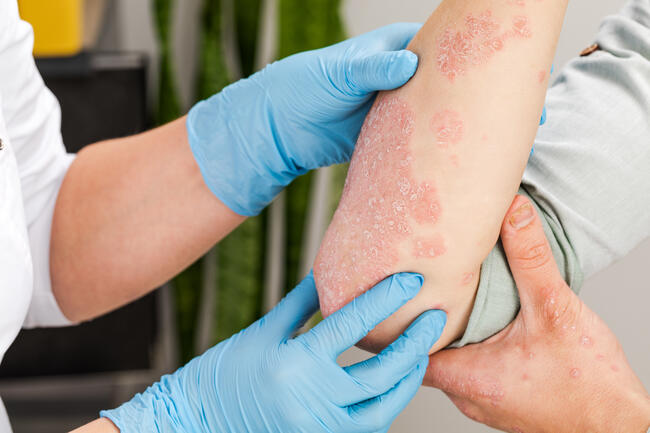
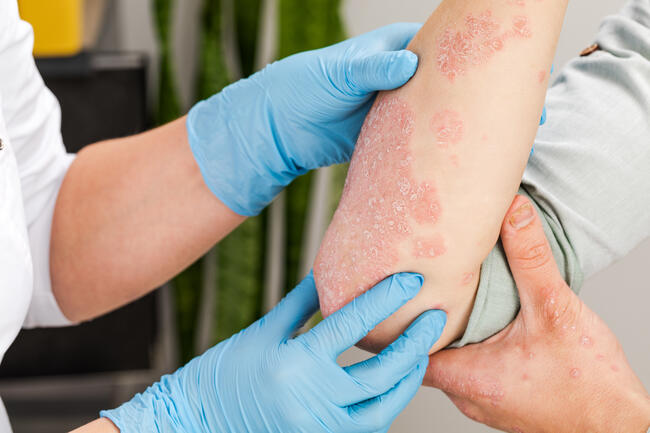
Unmet needs (moderate–severe plaque psoriasis): Only ~30% of dermatologists prescribe systemic therapies; many patients remain on ineffective topicals. IPC/National Psoriasis Foundation recommend escalation after topical failure and for high-impact areas (scalp, face, nails, palms/soles, genitalia), even with low BSA.
-
Oral targeted therapies: Patients strongly prefer oral over injectable therapy; TYK2 inhibitors (approved, emerging) and oral IL-23 receptor inhibitors (in development) expand non-injectable options.
-
Treatment selection: After topical/phototherapy failure, choose oral vs biologic via shared decision-making, balancing patient preference, adherence, and logistics (e.g., daily pill vs cold-chain injectable).
Reviewed by Riya Gandhi, MA, Associate Editor of Immunology Group
Dr Brad Glick discusses persistent unmet needs in psoriasis care, including undertreatment, low systemic therapy adoption, and challenges in high-impact disease areas. Learn how TYK2 inhibitors and emerging oral IL-23–targeted therapies are expanding options for patients who prefer non-injectables, and how shared decision-making can guide the choice between oral therapies and biologics to improve adherence and patient satisfaction.
Transcript
My name is Dr Brad Glick and I'm a board-certified dermatologist and I practice in South Florida.
With so many systemic options available, what are the key unmet needs you still see in managing moderate-to-severe psoriasis—particularly in relation to adherence and patient satisfaction?
Dr Glick: When we talk about unmet needs in matting our patients with psoriasis, we have to go a little bit backwards and say this. For the most part, only about 30% of our colleagues that are practicing dermatology are writing for primary systemic therapies such as biologics and oral systemic these days, to the best of my knowledge. And that means that somewhere around 65 to 70% of our colleagues are really not writing for systemic therapies regularly. That in general is an unmet need. One of the things that I will mention is that there is new thinking on behalf of the IPC, the International Psoriasis Council, and also National Psoriasis Foundation, putting in place a different approach to managing our patients with plaque psoriasis, not just looking at body surface area, but primarily those that even just fail topical therapy.
And so my point, one of the unmet needs has really been that many of our colleagues may in fact just be prescribing topical therapies. And when those topical therapies are not working any longer, it is time to move on to another systemic therapy, not another topical therapy. And so that's where we see that critical role and that gap and that unmet need for individuals who are being treated for plaque psoriasis. And of course, the third component of the IPC, the National Psoriasis Foundation's recommendation is to take a step back and look at those high-impact areas, the scalp, the face, the nails, the palms and soles, the genitalia to mention just a few of those difficult-to-treat or what we now like to call high-impact areas. And so there has been a significant unmet need in that area. And even though those individuals can be treated with topical therapy, I find personally, just my opinion, that topical therapies really fail in those particular areas and in those high-impact areas.
And so that is an opportunity for us to fill that gap, to meet that need for those patients that we're treating with plaque psoriasis who may have minimal or very limited body surface area, but because they have critical areas of need and treatment is an opportunity to proceed to that next step. And that next step is oral systemic therapy, or for that matter, biologic therapy as well.
How do TYK2 and other targeted oral therapies fit into the evolving treatment algorithm for psoriasis, especially for patients who prefer non-injectable options?
Dr Glick: First of all, when we're talking about systemic therapies in general, I would say that we are still living in a biologic era. We've spent the last 20 years or so utilizing biologic therapies and even convincing our patients who may have tripanophobia and have fears of using needles to treat their plaque psoriasis incredibly successfully for those of us that are using those agents. With that said, despite the fact that I don't think many of our patients are turning down the opportunity to utilize Botox or the opportunity to utilize GLP-1 agonists for treating their diabetes or for losing weight, with that said, recent data suggests from a great work by our colleague, April Armstrong, published just in the last couple of years, that when you ask patients what they prefer injectable versus oral by far and away, they prefer oral therapies. And so when we make that step to treat our patients with plaque psoriasis systemically, pills do really make a lot of sense.
Now, obviously those particular therapeutics that are just once a day are a lot easier to use. We've had products that are taken systemically, orally, twice a day, and that may create some challenges in terms of compliance, but I think it is true that when I ask my patients, "What would you prefer an injection or a pill?" By far and away, they prefer pills. And so I think it's exciting to know that we have targeted therapies like tyrosine kinase-2 inhibitors, one that has already been approved to market a couple of years back, and others that are emerging and coming into our toolbox quite soon, hopefully within the next year or two. And then finally, and coming quite soon, an oral systemic therapy that targets the IL-23 receptor. And that is highly intriguing for me too, because we know already that IL-23 is a critical cytokine that we know is responsible for the inflammatory changes that we see in our patients with psoriatic disease. And so it's exciting to know that we will have targeted therapies in two particular families in TYK2 inhibition and also IL-23 inhibition to create a different array of options for our patients who are suffering with psoriatic disease.
What clinical factors or patient characteristics help guide your decision-making when considering an oral therapy versus a biologic?
Dr Glick: When we're presented with someone who has now failed the topical therapy, perhaps they've undergone treatment with phototherapy for treating plaque psoriasis, we then have to take a step back and consider what are the next steps for our patients. And clearly systemic therapies, oral and biologic are our next most effective choices. And I think I say to my patients, we have a 50, 60, when some cases, 70% chance of clearing your skin completely at the end of one year, but how do we decide oral versus injectable? And as I have alluded to previously, there is data to suggest that our patients indeed prefer to take a pill over an injectable therapy. And I think the most important thing, particularly living in an era where injectables are used a lot by our patients in many different settings, not just even in dermatology, I think this gives us the opportunity to present options to our patients.
Oral over injectable is a decision that is shared between patient, their family members, and even their board certified dermatologist. And so those individuals who would like to make that next step, but maybe not have to prefer to wait for something to be delivered to their home, it has to be packaged in ice who will be compliant with taking an oral systemic therapy. I think that's a really great next choice for those individuals, but it's really a shared decision-making matter, and I think it's up primarily to patient ultimately, and of course, their family members who may be participating in their care.